Why WSL File I/O Feels Slow (and the 9P Fix That Nearly Doubled Throughput)
You run npm install in WSL on a repo living on C:\, and your terminal just sits there.
git checkout feels sticky. Bulk copies crawl. Simple file metadata calls add up into visible lag.
If that sounds familiar, this is the exact bottleneck I chased.
I pushed a fix in commit badaa3271343 after auditing where cross-boundary throughput was being capped in both WSL and Linux 9P paths.
The short version: this was not a transport rewrite. It was a targeted tuning pass that aligned protocol limits with what the transport could already handle, removing avoidable fragmentation and overhead.
#What this post covers
- A simple mental model for where WSL cross-boundary overhead comes from
- The specific caps that limited throughput
- The concrete changes made in WSL code
- Benchmarks, results, and why the improvement happened
- Practical advice you can reuse when debugging similar bottlenecks
Core insight in one line:
What I found was that the system wasn’t slow because of one bad limit, but because several of them were out of sync. Fixing one in isolation didn’t help, because something else would immediately take its place as the bottleneck.
#The pain in real workflows
Cross-boundary slowdown is not theoretical. It hits common developer loops:
- package managers (
npm,pnpm, etc.) touching many small files gitoperations over large working trees- toolchains doing repeated metadata reads (
stat,open,readdir) - bulk copy/sync between WSL and Windows paths
When these operations cross the Linux/Windows boundary, latency and fragmentation compound quickly.
#Mental model first: where the slowdown comes from
WSL uses the 9P protocol to handle cross-boundary file operations. Every time you open, read, write, or stat a file, messages are passed back and forth between the host and guest using 9P.
So throughput is not just "disk speed." It is also constrained by packet sizing and queue behavior.
Simple model:
larger transfer
  -> split into 9P messages
  -> each message crosses the boundary
  -> more messages = more overhead

effective throughput ~= useful bytes / (protocol overhead + boundary transitions + queue stalls)
And the key point: if your payload size is capped too low, you force extra fragmentation even when the transport could carry more.
#Boundary flow at a glance
[Linux process]
	|
	| read/write/stat
	v
[9P client in guest] --(packet size capped by msize)--> [transport queue/buffer] ---> [Windows host 9P side]
										     |
										     v
[NTFS or host FS]#The key knob: msize
msize is the payload size for 9P packets on the client side.
- smaller
msize-> more packets for the same transfer - larger
msize-> fewer packets and lower per-byte protocol overhead
But msize is bounded.
From Linux kernel behavior (net/9p/client.c)1:
- requested
msizeis clamped to transportmaxsize - then
TVERSIONnegotiation can reduce it again to what the server accepts
So in practice, the real msize is always the minimum of your request, the transport limit, and the server's limit:
// effective msize is bounded in practice
effective_msize = min(requested_msize, transport_maxsize, negotiated_server_msize);
This one equation explains most of the bottleneck: setting a larger value in one place does nothing if another layer silently clamps it.
#Constraints: what I could and could not change
Micro-summary: I could not swap transports, so the win had to come from removing avoidable limits in the active path.
WSL currently falls back to trans=fd for its active 9P transport. The trans=virtio path is theoretically faster, but that route is currently disabled upstream by Microsoft due to an undisclosed bug.2
Because transport replacement was off the table, I optimized trans=fd and related caps in-place.
When I traced the path, the throughput loss came from conservative hardcoded ceilings:
- guest-to-host request cap on
\\wsl$was low trans=fdnegotiation was effectively stuck far below host allowance- protocol payload sizing and socket memory sizing were coupled, which blocked clean tuning
In other words, the system had headroom, but configuration ceilings prevented reaching it.
#What changed
Micro-summary: I raised each bottleneck to the highest constraint-backed value, then decoupled protocol payload tuning from transport buffer tuning.
I went through each cap and adjusted it to match real transport constraints.
#1. Guest to Host (Windows -> \wsl$)
File: src/linux/plan9/p9handler.cpp
- before:
MaximumRequestBufferSize = 256 KiB - after:
MaximumRequestBufferSize = 1 MiB
// before
MaximumRequestBufferSize = 256 * 1024;

// after
MaximumRequestBufferSize = 1024 * 1024;
In the WSL plan9 handler, Tversion size is clamped using this constant. At 256 KiB, larger operations fragmented earlier than necessary. Raising it to 1 MiB removes that artificial early ceiling for this direction.
Why this matters: fewer early splits on large operations.
#2. Host to Guest (trans=fd)
Files:
src/linux/init/drvfs.cppsrc/linux/init/main.cppsrc/shared/inc/lxinitshared.h
Protocol side:
- before: effectively
64 KiB - after:
256 KiB(262,144) viaLX_INIT_UTILITY_VM_PLAN9_MSIZE_FD
I chose 256 KiB because 262,144 is the host negotiation ceiling for this path. This sets protocol payload size to the highest useful value accepted by negotiation.
Transport buffer side:
- before:
LX_INIT_UTILITY_VM_PLAN9_BUFFER_SIZE = 64 KiB - after:
LX_INIT_UTILITY_VM_PLAN9_BUFFER_SIZE = 128 KiB
LX_INIT_UTILITY_VM_PLAN9_MSIZE_FD: 65536 -> 262144
LX_INIT_UTILITY_VM_PLAN9_BUFFER_SIZE: 65536 -> 131072
The core flaw here was coupling: msize (protocol payload) and socket buffer sizing (queue behavior) were tied together. That forced a bad tradeoff: keep payloads small, or push memory behavior too aggressively. I separated these knobs so protocol and transport could be tuned independently.
I then moved buffer size from 64 KiB to 128 KiB. I stopped at 128 KiB intentionally because Linux internally doubles socket buffer accounting. This lines up naturally with the 256 KiB protocol-side msize target (262,144) without overcommitting memory.
Why this matters: larger payloads plus stable queue behavior under sustained transfer.
#3. Host to Guest (trans=virtio path)
File: src/linux/init/drvfs.cpp
- before:
msize=262144 - after:
msize=512000
This specific number comes straight from the Linux 9P virtio transport (net/9p/trans_virtio.c), which defines maxsize as:
PAGE_SIZE * (VIRTQUEUE_NUM - 3)
With PAGE_SIZE=4096 and VIRTQUEUE_NUM=128, that evaluates to 512000 exactly.
PAGE_SIZE * (VIRTQUEUE_NUM - 3)
4096 * (128 - 3) = 512000#Why these changes work
Micro-summary: align every layer, then fragmentation drops naturally.
Each adjustment reduces avoidable fragmentation at a different layer:
- larger negotiated payloads -> fewer 9P messages per transfer
- fewer messages -> fewer boundary transitions and less per-message overhead
- better buffer sizing -> smoother queue behavior under sustained transfer
This is the "aha": throughput improved not from a new architecture, but from removing layered caps that were accidentally fighting each other.
#Benchmarks and results
I benchmarked before and after on the same machine/workload profile used during validation of the patch.
Method summary:
- compared both directions:
WSL -> C:\andC:\ -> WSL - measured sustained throughput for large sequential transfers
- ran with old constants vs patched constants
Results:
| Direction | Before | After | Improvement |
|---|---|---|---|
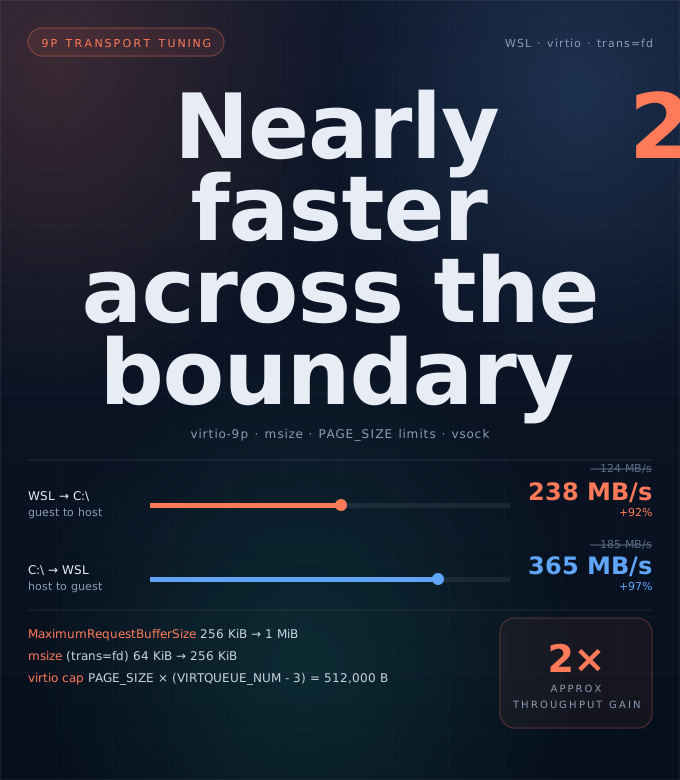
WSL -> C:\ | 124 MB/s | 238 MB/s | +92% |
C:\ -> WSL | 185 MB/s | 365 MB/s | +97% |
That is near-2x in both directions.
#Practical takeaway
If you are debugging cross-boundary I/O in WSL, start with these questions:
- Where is
msizerequested? - Where is it clamped by transport?
- What does negotiation actually settle on?
- Are protocol payload and transport buffer knobs coupled?
Most of the time, your effective ceiling is the minimum of several layers, not the value you set in one config path.
This case is a good reminder: substantial gains can come from reading constraints end-to-end and aligning them, even without changing the high-level architecture.
Memorable rule of thumb: performance bottlenecks often hide in the minimum, not the maximum.
#Change summary (before -> after)
p9handler.cppMaximumRequestBufferSize:256 KiB (262,144)->1 MiB (1,048,576)drvfs.cpptrans=fdmountmsize:64 KiB (65,536)behavior ->256 KiB (262,144)lxinitshared.hLX_INIT_UTILITY_VM_PLAN9_BUFFER_SIZE:64 KiB (65,536)->128 KiB (131,072)lxinitshared.hLX_INIT_UTILITY_VM_PLAN9_MSIZE_FD: newly introduced as256 KiB (262,144)for explicit fd protocol sizingdrvfs.cpptrans=virtiomountmsize:262,144->512,000
#References
- Commit: https://github.com/Dark-Matter7232/WSL/commit/badaa3271343
- Patch: https://github.com/Dark-Matter7232/WSL/commit/badaa3271343.patch
- Linux 9P docs: https://docs.kernel.org/filesystems/9p.html
- Linux 9P client logic:
linux/net/9p/client.c - Linux virtio 9P transport logic:
linux/net/9p/trans_virtio.c - Linux fd transport logic:
linux/net/9p/trans_fd.c - WSL init + plan9 paths:
WSL/src/linux/init/andWSL/src/linux/plan9/
#Footnotes
-
Request clamping and negotiation path reference:
linux/net/9p/client.c. ↩ -
Upstream-path constraint and patch context: https://github.com/Dark-Matter7232/WSL/commit/badaa3271343 . ↩